OpenZhenZhen AI 提示词画廊 · gpt-image-2.5 · image
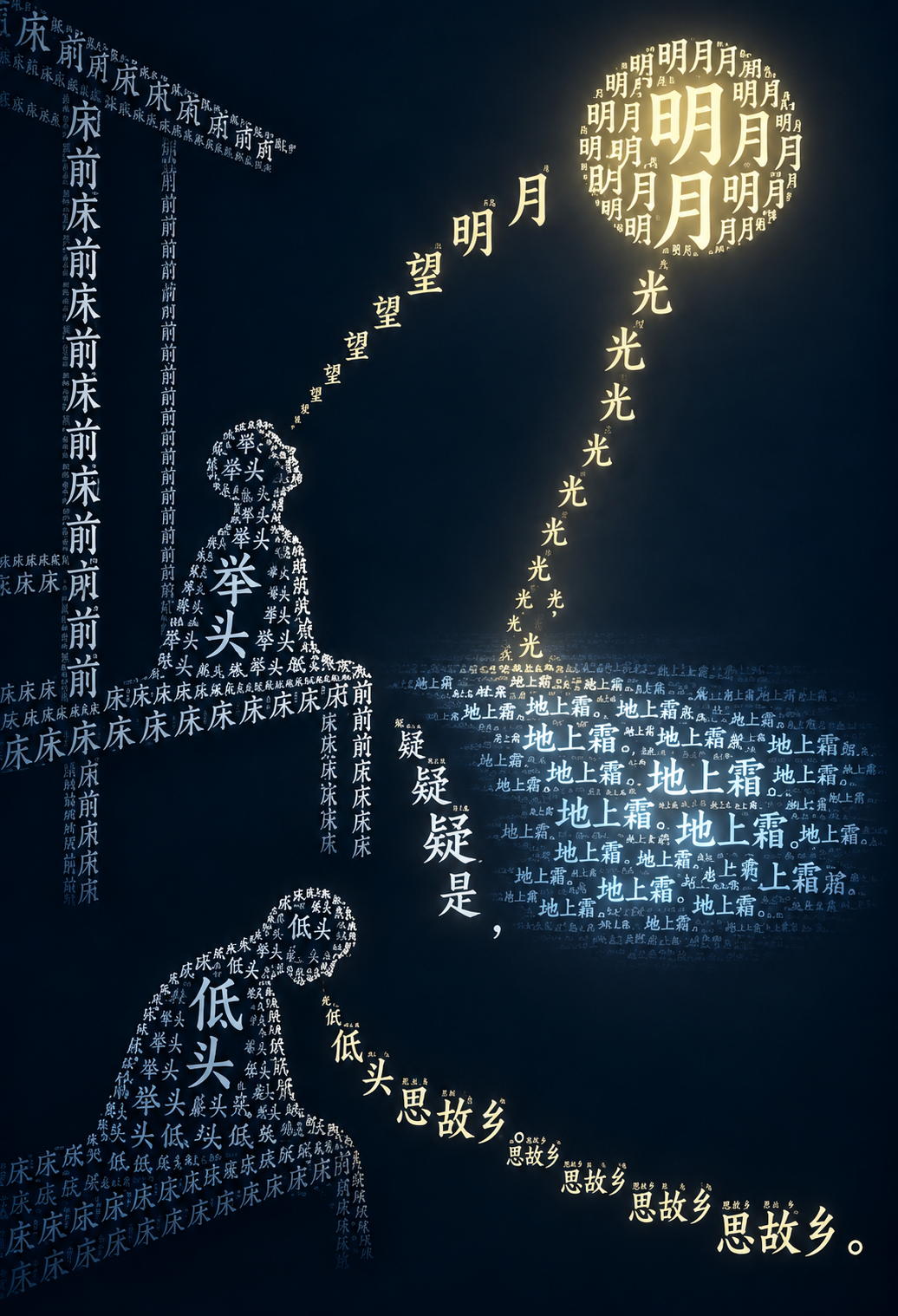
诗词文字构成的意象图
Imagery Formed by Poetic Text
以诗中字词自身构成意象图:字的位置与方向同时承担造型和阅读路径,完整保留原诗。
提示词 / Prompt
中文提示词
将下面的完整原诗制作成一幅只由诗中文字构成的文字意象图。字的位置和走向共同形成画面,使观者既能辨认意象,也能沿着清晰路径读完整首诗。必须按输入原样使用诗文;不要翻译、改写、添加标题或虚构内容。 原诗: 床前明月光,疑是地上霜。举头望明月,低头思故乡。 先只从诗中辨认明确写出的事物及关系:什么在上、什么垂下、什么在移动以及移动方向。不得增添意象。每个画面事物只能由诗中指称或描写它的字构成。把关系转化为空间形式:垂落的意象沿弧线向下排列,高处意象向上竖排,风或方向性运动则让字斜向穿过画面。表达疑问、否定、设问或比喻的字(例如“不知”“谁”“似”)不代表具体事物;将它们放在留白处或两个意象的交界,让位置表现其作用。 直接以字形搭建可读的文字图像,通过字号、间距、方向和重复使用构成画面。不要添加绘制的物体、图标、装饰符号,也不要出现原诗之外的任何可见字符。可以重复使用诗中文字填充构图,但须建立一条明确的阅读路径,按原顺序完整呈现每个原文字和标点,不得遗漏或改动。整首诗须可读,未读过原诗的人也应能辨认画面所表现的场景。 完成前逐项核对:所有可见字形均来自原诗;每个意象只由指向或描写它的诗中字构成;画面可辨认;沿阅读路径能按原顺序准确读出完整原诗一次。画布形状随诗的构图需要确定;来源未指定固定比例或光线。
English prompt
Create one typographic image composed only of characters from the complete source poem below. The positions and directions of the characters form the imagery, so viewers can both recognize the scene and read the entire poem along a clear path. Use the supplied poem exactly as written; do not translate, paraphrase, add a title, or invent content. Source poem: 床前明月光,疑是地上霜。举头望明月,低头思故乡。 First, identify only the things and relationships explicitly present in the poem: what is above or hanging down, what moves, and in which direction. Do not add imagery. Compose each depicted thing from only the poem characters that refer to or describe it. Translate relationships into spatial form: arrange hanging imagery downward on a curve, high imagery upward, and wind or directional motion diagonally. Characters expressing doubt, negation, questions, or metaphor (for example “不知”, “谁”, or “似”) do not stand for objects; place them in negative space or at the junction between images so their function is visible. Build a legible calligram from the glyphs themselves; use their scale, spacing, orientation and repetition to make the image. Do not add drawn objects, icons, ornamental marks, or any visible character absent from the poem. Reusing poem characters is allowed to fill the composition, but establish one unambiguous reading path that reproduces every original character and punctuation mark in the original order, with none missing or altered. Keep the whole poem readable while making the depicted scene recognizable to someone who has not read it. Before finalizing, verify: every visible glyph comes from the source poem; each image element uses only its own referring/descriptive poem characters; the scene is recognizable; and following the reading path yields the complete poem exactly once in its original order. Let the canvas shape follow the poem's composition; no fixed aspect ratio or lighting is specified.
探索更多图片和视频提示词 · 生成图片 · 生成视频 · 在 AI 画布中创作
相关作品
- 特斯拉电动车核心部件示意全景
横向概念示意海报:以未指定车型的特斯拉电动车为中心,周围安排若干模块放大细节。电池包、电驱电机、逆变器/电力电子、车载充电器、热管理回路、悬架与制动、充电接口均为整理者选定的示意模块,不是来源列明的清单,也不代表特定车型布局或工程规格。 / A landscape conceptual overview centered on a Tesla EV of unspecified model, surrounded by selected module detail callouts. Battery pack, drive motor, inverter/power electronics,
- 日系负片里的记忆碎片
A 9:16 candid Japanese negative-film style portrait. The adult person, unposed walk and quiet neighborhood lane are replaceable curator-selected defaults, not subject or scene details supplied by the source. The currently configured ref-10a-v1 is used as the generic person identity reference and is
- 1girl
gpt image2.5生成
- 法式风情地标美食海报
A premium, clean and elegant poster concept built from the source’s broad request. Eiffel Tower, Arc de Triomphe, ratatouille and Provençal bouillabaisse are curator-selected illustrative examples, not details stated by the source; they can be replaced in a future variant. The source example image i
- 梦回江户浮世绘古典人物像
A reference-led Edo-period ukiyo-e portrait transformation that preserves the supplied person’s facial identity while restyling hair, clothing and accessories in traditional Japanese fashion. The current ref-10a-v1 is the generic person preview for this workflow, not a claim about any external named
- 盛世长安万国来朝图
A text-driven historical reconstruction of the source scene: an aerial view of Kaiyuan-era Chang’an, Emperor Xuanzong and Yang Guifei looking out from Hanyuan Hall, and a distant tribute procession. The configured generic portrait is used only as a face-identity anchor for Yang Guifei in this genera